Creating a seamless and user-friendly intranet experience for a global team.

The context
Connecting People and Information Across a Global Enterprise
Cencora’s (then AmerisourceBergen) acquisition of Alliance Healthcare introduced new digital access, content translation, and employee engagement requirements. The remote and hybrid work model, combined with a complex technical architecture, created disconnected silos of information, making it difficult for team members to find relevant information.
My role
I participated in the entire research and design process, spanning from initial discovery to final delivery, working closely with content strategists, IT architects, regional stakeholders, and HR leaders over a six-month period.
The Challenge
With the rapid growth of employees and contractors in new global markets, significant challenges arose in digital access, employee engagement, and content localization. The existing intranet platform, initially designed for a US and Canadian workforce with less distribution, could no longer meet the increasing demand.
Meanwhile, the rise of hybrid and remote work, along with the increasing presence of team members in warehouses and shipping, has introduced new behaviors and expectations. Employees navigated between multiple "my" sites and had difficulty locating resources. From benefits to technical support, essential information was scattered across regional and departmental portals.
The increased complexity of backend systems made the problem worse: different systems stored different content, and links to critical tools were buried, outdated, or inaccessible depending on the user’s location.
The Process
Discovery & Research
Our team examined workshops and focus groups led by an external team, supplementing this with stakeholder interviews involving employees from various disciplines, including HR, IT, and regional leaders, to gain a comprehensive understanding of the diverse business objectives. Simultaneously, we performed usability audits on the current intranet, pinpointing areas with high friction.
“Time tracking is important, but it’s poorly done; I really dislike the setup. I have to click maybe 10 times to check in and out, which is very cumbersome. Additionally, if I accidentally check in, it can’t be corrected.”
“A uniform single experience would be nice with fewer website registrations and password creations. Then, if the learning portal and the compliance stuff were all coming from the same place, that would probably be easier to manage.”
Our research revealed issues such as information overload, the demand for a seamless digital experience, difficulties in accessing content, and the need for globally relevant and translated content.
The team soon understood that the goal was more than just redesigning a website — it was about fundamentally changing how employees engage with the company's digital platforms. The solution had to support multiple languages, roles, access levels, and regional compliance, all while being user-friendly and cohesive.
Mapping employees’ personas and their digital journeys
My task was to synthesize the findings about Cencora’s extensive and diverse range of employee types who use its digital environment, then present them to the team and stakeholders concisely and in a way that is easy to act upon.
This is where my interest in the Myers-Briggs personality type framework influenced how I presented our diverse group of employees. I categorized employee types into three primary personas (personality profiles): Desk, Contract, and Field Associates.
Desk associates
This employee works in a designated location, whether in an office or remotely, and often encounters information overload from various types of communication.
Contract Associates
This employee may have designated work locations, either in an office or remotely, but they are generally more mobile and may encounter challenges with limited access and connectivity while traveling.
Field Associates
This persona likely lacks a dedicated office space or company device. They may use shared devices, have limited access to the web, or rely on personal devices or managers for updates.
Each persona was assigned specific traits or needs based on their personality type, which helped map user journeys and illustrate similarities and differences across departments and countries. We held workshops with the team and stakeholders, sharing our research results and personality profiles. This framework helped pinpoint the diverse user needs that the design should target and encouraged team participation.
Alignment on goals
Following the presentation, we defined key goals to steer our design efforts, which received leadership approval and united the team.
Personalization & Localization at Scale
Ensure that all associates, regardless of region or role, can access information in their preferred language, time zone, and at the relevant level of detail. This includes self-selected language options, location-aware communication, and opt-in/out capabilities to reduce noise and increase engagement.
A unified, consistent digital experience centered around human storytelling.
Consolidate tools and communication channels across regions to reduce confusion and improve usability. Standardize platforms, enhance mobile access, and share stories that reflect shared values. Create dedicated spaces for employee recognition, celebrations, and internal updates to foster a sense of community and unity.
Centralized Access to Tools and Support
Create a self-service hub for pay, benefits, IT help desk, and HR policies with simplified login, consistent platforms, and improved Workday usability. Enhance intranet search and filtering for easier access to content. Provide training to increase tool awareness and efficiency, supporting associates in completing tasks and navigating systems more effectively.
Information architecture & prototyping of an intranet on the Akumina content management system
The team decided to use Akumina as the foundation for the intranet. This CMS provided the necessary framework to achieve our objectives. We also worked with an outside contractor who specializes in building sites with Akumina.
After conducting a competitor analysis and compiling company branding guidelines, I created initial wireframes grounded in that research, previous studies, and business objectives. These wireframes later developed into interactive prototypes. My primary focus was on enabling employees to access personalized, localized content, utilizing tools to foster global engagement, simplifying access to tools, and strengthening the company culture through shared stories and recognition.
We underwent multiple rounds of design reviews, receiving input from teams such as marketing, IT, and other stakeholders. This helped improve navigation, information structure, and branding.
The Solution
Final designs for hand off
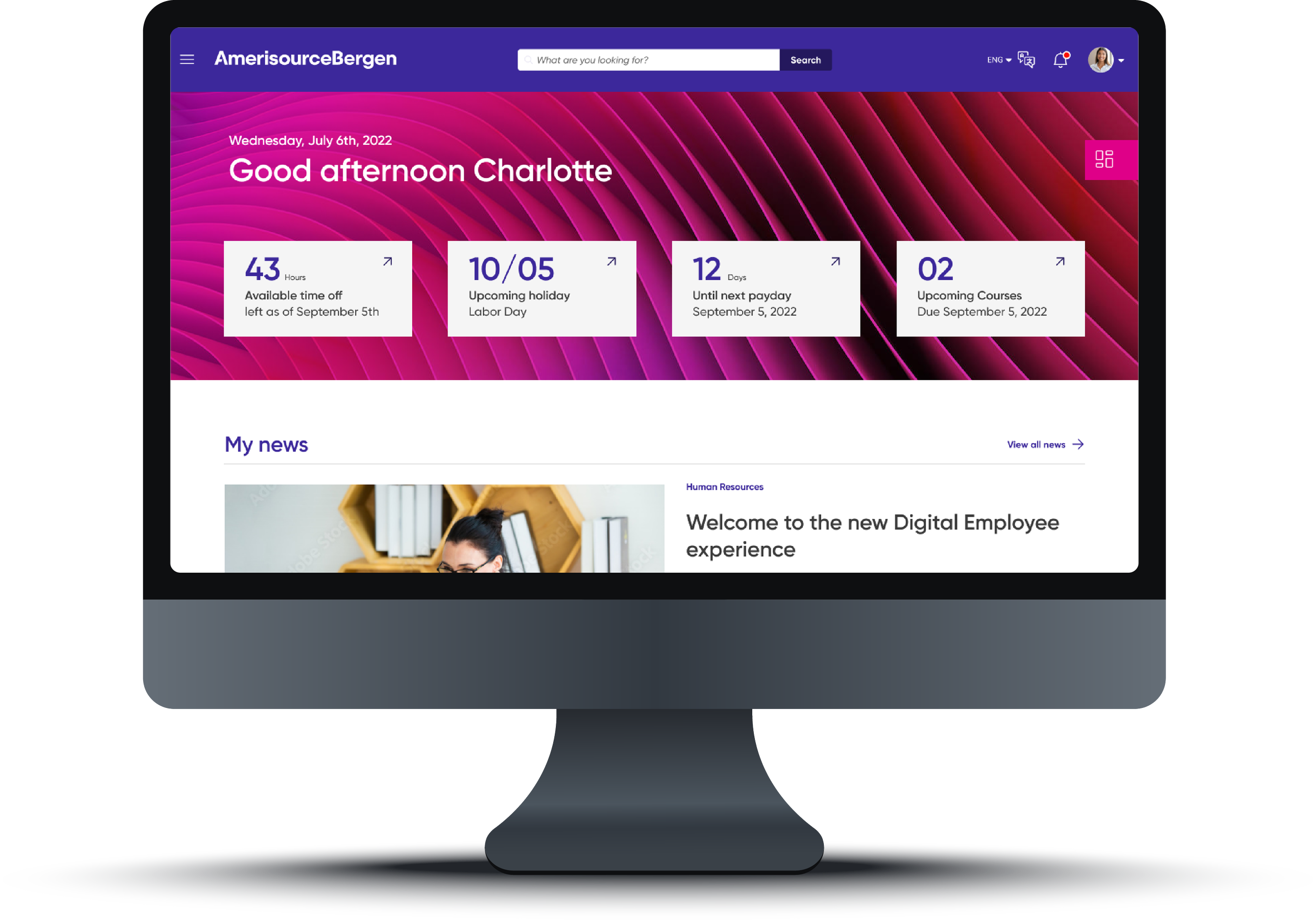
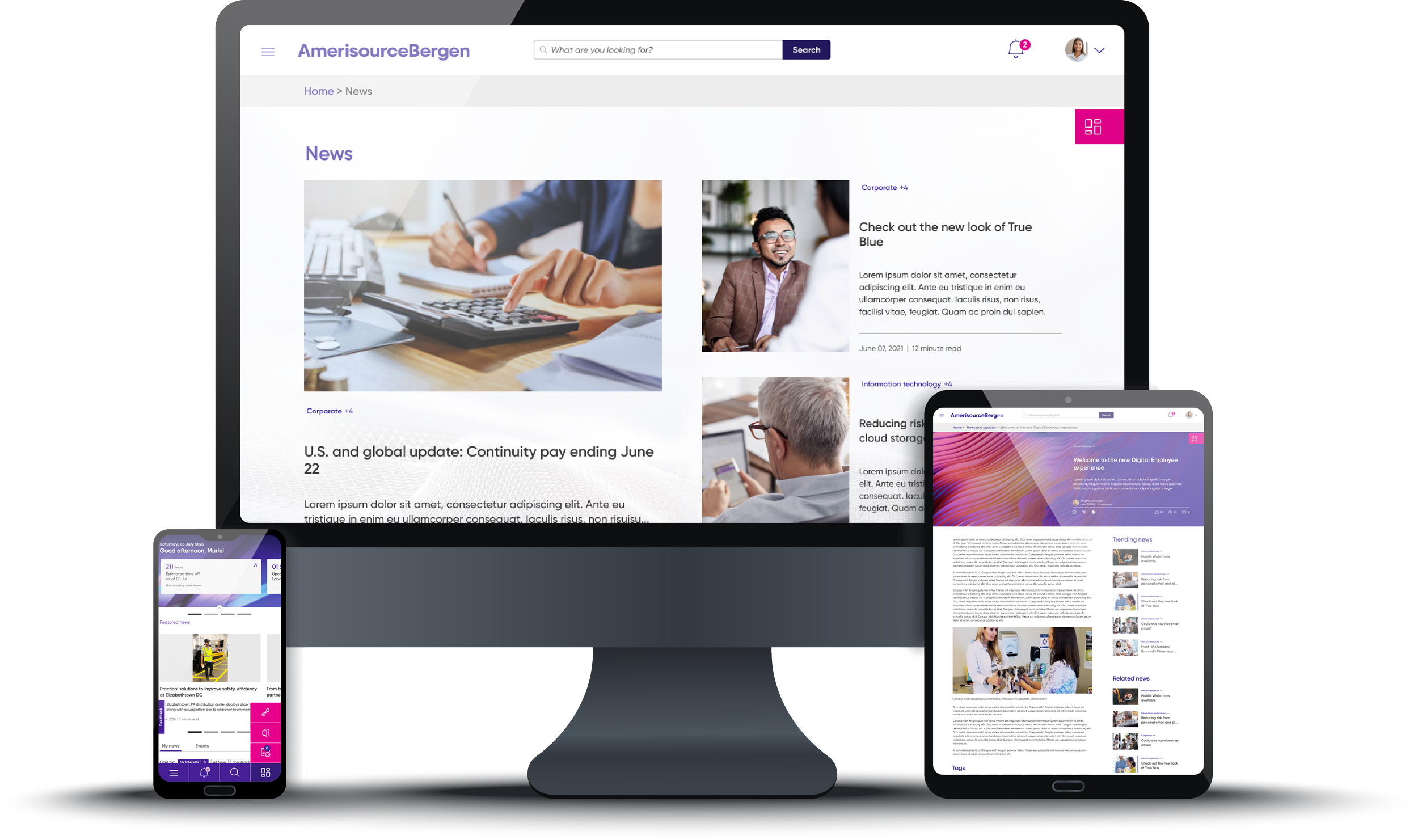
The final designs aimed to provide a personalized and user-friendly experience for all employees, regardless of their location, role, or device type. Based on a unified design system, the platform includes:
Personalized Homepages with role- and location-specific quick links, announcements, and tools
Localized Content Areas offering auto-translated updates with human QA for critical communications
Streamlined Navigation through a federated search bar that surfaces content from across legacy systems
Mobile-Responsive Design to ensure seamless access for frontline and remote workers
The Impact
After launching the intranet, it continues to grow in order to meet the changing needs of employees
To promote adoption and facilitate the transition, we developed interactive onboarding modules and training resources, including videos, walkthroughs, and quick guides, followed by a phased pilot launch.
The team felt confident after launch that we delivered a consistently engaging and global intranet experience that enhances access to tools, fosters cultural connection through storytelling and recognition, and helps employees navigate their digital workplace with clarity and confidence. We had to make concessions due to time and constraints, but the foundation was set for the intranet experience to evolve over time with employee feedback.
30% increase in employee engagement and usage within 3 months of launch.
Enhance employee engagement with various internal teams and services by creating dedicated intranet pages.
User satisfaction scores from the feedback survey rose from 3.2 to 4.5/5. 5.60% reduction in
Received internal recognition from the Global HR and IT teams as a model for future platforms.
Reflection
This project taught me a great deal about designing for diverse interests, complexity, and scale. I realized the importance of investing heavily in discovery, especially when working with legacy systems and global stakeholders.
If I had the chance to do it again, I would have pushed for more testing of the intranet architecture with users throughout the entire project. This would have helped promote adoption and made the transition smoother at launch. I also wish I could have spent more time improving the digital connection for field associates, like the company’s warehouse and shipping employees.
However, timing and coordination with contractors made that impossible. Nevertheless, this challenge enhanced my ability to design within constraints rather than against them.